STATEMENT
All my works inhabit a mythical world, one rooted in the blank spaces of memory, which I fill with mysticism and folklore. Through the lens of memory, I gain the freedom to explore recollections (be it my own or collective) that resist accuracy.
I paint a world where the very foundations, the mortar and building blocks, are shaped by imagined or half-recalled impressions of legends and stories. In this space, I might allow myself to invent my own reasons for why the sun rises, why the moon sets or why the seasons change. Not as natural phenomena, but as carefully managed laborious tasks, often enacted by tireless figures, workers or animals whose only tools could be a bicycle and a few sacred ornaments, keeping the whole thing (thing being the world) from falling apart.
I hope to keep a ceremonial sincerity to these acts, sometimes creating scenes that can seem celebratory. Like decorating for a party. I want my work to reflect both: the ritual and the celebration and sometimes the common.
The blurriness of memory can turn the mundane into something magical. Each painting lives in that imagined, barely recalled world: a space where myth and memory blur, and reality is playfully reassembled into an almost forgotten scene
– Astral Magazine
An interview with: Taegan Treichel
Astral speak with magical Copenhagen based painter @taegantreichel
“All my pieces inhabit a mythical world – one that has its roots in the blank spaces of memory – spaces that I fill with mysticism and folklore…. by painting a world in which the mortar and building blocks are created by an imagined or recalled impression of myth and ceremonies, I aim to infuse the same life to my paintings, the way time and the inaccuracy of recollection has given my own memories an air of magical mysticism. This is the place in which all my paintings reside. Not a tangible place, but rather an imagined and recalled world.” – taeganadam.com
Read the full interview with Taegan Treichel below…

First of all, where are you from and what was a key motivation for you to start painting in your early twenties?
I’m from Denmark. I grew up in a little town called Kolding (in Denmark it’s a city; for the rest of the world it would probably be a town or village). We lived just by a swamp and fields with cows and sheep bordering up to the city. When I was little, me and the other kids from the neighbourhood would play in the green area, but we weren’t allowed to go too far into it, which gave it an air of mystery and danger. I felt it was this natural highway going out of the city; like you could very quickly find yourself lost outside of the city without even realizing how far you had gone. Looking back, the real reason we weren’t allowed to go so far away was probably just so we could be home for dinner. Denmark is a very safe country.

My motivation to start painting in my early twenties came from the freedom it gave me (and still gives me) compared to drawing, which I did ever since I can remember. At the time, I was part of a group of friends who would hang out and have these artistic get-togethers. Some of us were into drawing, like me, while most were writers; a lot of aspiring poets! I guess we were always trying to influence each other. The writers were constantly talking about the tactile feeling of their different typewriters, so we (the drawing kids) felt inspired to explore a new medium as well. That’s how we ended up trying painting. It opened a lot of possibilities in my process.

Where did your love of mysticism and folklore stem from, and could you describe some particular key ideas, stories, or personal areas of study within those fields that you feel have impacted your view on the world and your creative process as an artist?
It stems from stories we were told as kids. I’m not quite sure where exactly we heard them; I think they might have told us about the elves and the “brewess” (mosekonen) in kindergarten, maybe also just in Danish and Scandinavian mainstream media. I seem to remember there were a lot of stories and shows about trolls and elves (nisser), elven folk, and so on. Maybe I just remember it like that because it fascinates me. But it gave me this very clear image of where the fog came from and what was hiding in there. We lived right next to a swamp, so there was a lot of mist a lot of the time. I became very aware of these “magical” powers right in our backyard.

The idea that a symbol or a mark on a piece of paper has the means to shape or foretell something about the physical world (like a cross, a tarot card, etc.) was, at one point, a way for me to imbue meaning into my work. Like I could borrow the gravity from a symbol and use that power in my art. I’ve since strayed away from using “borrowed” symbols in my work. I’m still very inspired by the concept of the power a symbol can have, but I’ve found that I would rather utilize my own homemade symbols and feelings in my work. I can be more honest in my process and make it my own. I will still use known symbols, but more to enforce and enhance what I’m trying to create; not use the borrowed symbol as a pillar of meaning in my piece; more like a single sign showing the viewer where to look. I hope that makes sense.

Could you tell us about the concept of ‘mythical ceremony’ within the context of your work and how that interweaves with memory and youth?
In some ways, I see ceremonies as parties, but just parties that took place long ago. And because they happened long ago, and time seems to enhance and distort events, we start viewing these events in a different light. That party suddenly finds that it has increased in size, and the guests who were invited to that party have changed into creatures and divine characters. The reason for throwing this party isn’t just because we want a normal surprise party; the reason has evolved, for example into the celebration of a lunar god’s fascination with a sun goddess and how they can finally meet during the long summer nights in June.

The concept of a mythical (party) ceremony relates to how myths gain significance over time, often taking on a serious, almost sacred tone. I’m interested in how that seriousness might come from the distance created by time and the way memory distorts things. I like to imagine what happens if we reverse that process; if we could turn time backward, would the myth become less serious, more playful, maybe even silly?

On some level, I’m exploring history’s memory of its own events, and how the memory of these events has altered their character. At least, that’s what I’m sometimes telling myself. Like my memory of my own childhood, how most things seemed unexplored and mystical. But also, if we go with the idea of history being an entity with memories, then we could say that the myths took place when history was a child. Therefore, I can, if I want, add some more childish elements to my pieces. But it also just gives me the freedom to play around with some ideas that I find funny, and sacred, mixing the two.

Nature is a prominent theme within your works. Could you tell us about how you view the consciousness-relationship to nature within your work, and perhaps how the concept of ‘animism’ is translated within the worlds you create?
There are different reasons why most of my paintings take place in nature. First, to me, it seems like a way to create a setting with a clean slate. It doesn’t tell the viewer about any specific time in history, or even a specific place. Most of my paintings are set in the Northern Hemisphere; it’s where I’m from, and it’s what I know. I like the anonymous quality of nature. I feel that the nature setting also just fits the theme. If some sort of otherworldly magical event were to happen, I think it would happen somewhere in a forest, or on a field of grass, a mountain, etc.

There’s actually a rumor going around Copenhagen (maybe mostly in my friend group and other adjacent groups) that a woman saw a ‘nisse’ (elf) in a basement somewhere in inner Copenhagen. But I feel like so much weird stuff already happens in the cities, so maybe, if you ask me, nature should keep most of the magical and ethereal events. On a more technical level, I like painting nature. I like that the lines don’t need to be straight. I like that I can keep the shapes loose, especially when I’m so detailed and meticulous about almost all other aspects of the process. The concept of animism isn’t something I know much about. I kind of use it in my work, but in a veeery loose way; more like a tool to make my mind create a creature that would represent a place or an idea, etc. But it’s mostly there to back up the feeling that I want to get across in the piece.

Have you ever been inspired by an otherworldly experience (e.g. hallucinogens, dreams, or otherwise) that influenced your outlook or ideas within your art or a certain piece?
It’s hard for me to say. The act of drawing inspiration from something is almost impossible for me to pinpoint. It’s sort of an emotional experience, and it can literally come from anything. But I guess there are feelings that I want to evoke when I set out to make a piece. But then again, it’s a mess of thoughts, memories, stories, images, feelings (also feelings in the sense of a bee landing on your arm under the sun, that quick little connection to your surroundings), that, and then a thousand other things. So, in a way, yes, I am inspired by some things from the question above, but also just so many other things. I don’t think I can be more specific.

Are there any particular ideas or concepts that have captivated you in recent times that you wish to disclose?
I’m exploring this idea of beings making the sun come up or creating the night; beings who understand the cycle and perform it, knowing night will always follow day, and day will follow night again. Having these beings that make sure all these natural acts happen, making sure that the world keeps spinning. I think it’s a reaction to a world that seems to be more unpredictable than when I was younger. It feels comforting to have someone else take care of the bigger things. Have them be more grounded, and have the job done by delicate, caring hands.

What do you love the most about painting, and what lights the flame of passion inside of you?
I love experiencing a piece coming together. I enjoy the problem-solving aspect of it; how do I achieve this specific feeling that I want to conjure up? It can be an emotional experience, I want the piece to have a certain feeling, and I might share that feeling while painting. I love being in a flow state while painting. I enjoy sitting there alone, having my little personal experience with a piece. I just very much enjoy the process; it’s very pleasing to me to sit with a painting (if it’s going well!!). If the paint isn’t listening to me, it can feel like an elegant dance morphing into a wrestling match.

What does ‘spirituality’ mean to you?
It’s a connection to my surroundings. It’s abstract, hard to explain. Weird example, but, everyone has the same interaction with water when drinking it, and always has. People do it, animals do it, plants do it. That connection travels through time; it’s a shared experience. It’s a connection to smaller things; any small gesture can become a ceremony, carry weight, and hold meaning. In a way, it’s about getting closer to others (people, animals, or plants), not necessarily through touch or talk but just as much through a shared experience or action. That connection.
Interview with artstoheartsproject
How Taegan Treichel Blends Memory and Myth into Whimsical Artworks

Taegan Treichel is a Danish artist whose work blurs the lines between reality, memory, and imagination. In this interview, Taegan shares how his childhood fascination with folklore and the distortion of memory inspire his whimsical and magical paintings. He talks about blending serious mythical elements with playful touches, like party decorations and treats, to create a unique and lighthearted take on storytelling. Through this conversation, we also learn about his creative journey across countries like China, Holland, and France, and how these experiences shaped his work. Taegan opens up about the role of humor, digital tools, and cultural inspiration in his creative process, giving us a deeper understanding of how he creates his enchanting, mythical worlds.
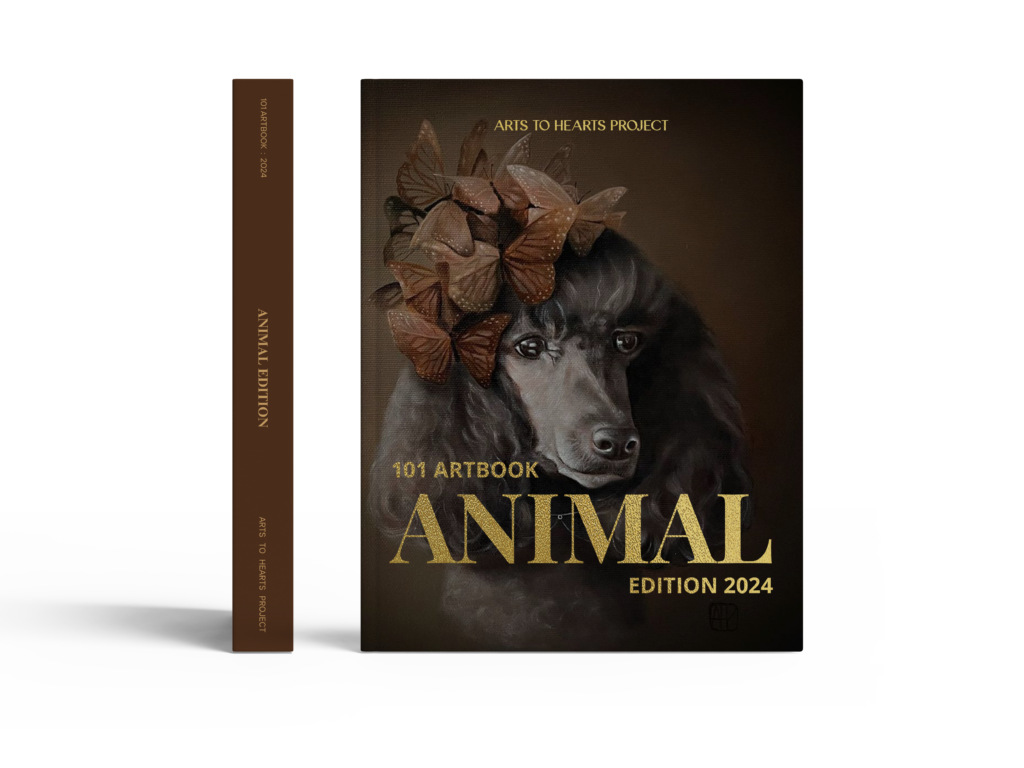
Taegan Adam Treichel is a featured artist in our book “101 Art Book: Animal Edition .” You can explore her journey and the stories of other artists by purchasing the book here: https://shop.artstoheartsproject.com/products/the-creative-process-book

Taegan Treichel, an artist who began painting at the age of 22. Shortly after venturing into painting, he secured commissioned work as an artist, eventually becoming an in-house artist at the Imagineimagine Foundation in Holland in 2017. In 2018, he traveled to China, concluding with a solo exhibition at “The Bookworm” in Beijing in 2019. His education in Paris at the LISAA animation school introduced him to digital tools, leading to freelance work in gaming. Since 2019, he has consistently exhibited and contributed paintings to galleries in Denmark and abroad, including Strandgalleriet in Vejers, 3A in Copenhagen, Adah Rose Gallery in Washington, D.C., Wasuka Art Management in Singapore and The Nanny Goat Gallery in California.
1. Taegan, your work blends myth, memory, and folklore in fascinating ways. How did this unique approach to storytelling in your art come about?
I am interested in how myths have developed through time and in people’s minds. Many myths have a serious aura about them, and I wonder if the mere fact that so much time has passed has given them more gravity. As if the more time has passed, the more serious they get. In my work, I like to play with the idea of turning time backwards. If we could turn time backwards, would the myth gradually lose its seriousness and become more and more silly? Has the myth only gained seriousness through the distortion of time and memory? The distortion of memories, as I like to think of it, sort of gives me the freedom to paint more magical and silly scenes, inspired by myths.
By using the lens of memory, I get the freedom to play with recollections that cannot be accurately recalled, elevating the actual real-life moment to a higher significance, evolving the original experience that was lived, as if one was part of a mythical ceremony.
Taegan Treichel

2. Your paintings evoke a sense of mysticism and humor. How do you balance the gravity of mythical elements with lighthearted, whimsical touches?
I believe most people see mythical stories, paintings, songs, etc. as something very serious. So the gravity of the mythical elements are handed to me by default, and the challenge is bringing in the whimsical and humorous elements. It’s still a work in progress, and I don’t feel like I succeed every time. I am lucky that there have been lots of artist who painted lots of scenes from myths through history, so there is almost already an established aesthetic, which I can echo to a certain degree and then add my own whimsical elements to bring it to a more light-hearted humorous universe. I feel like humour has its place in folklore.

3. Memory seems to play a central role in your art. Can you tell us more about how your personal memories influence the scenes you create?
Growing up, I was quite scared and enthralled by our local folklore and myth. Thinking back to my childhood, I remember it as if folkloric elves and marsh wives were living creatures, and their presence was something I had to deal with in daily life. If I was surrounded by fog, for example, I remember thinking that I had to hurry home before the marsh wife would start “brewing the mist” (which is an old Danish expression). So, in my mind, I was leading quite a magical life. With time, my memories of these magical scenarios have grown in intensity, and I find that distortion of memory inspiring. That we remember things that aren’t necessarily true, and what these more or less accurate memories or narratives have morphed into. So, it’s more the distortion of memory itself than the actual memories that I use in my paintings.

4. You’ve explored both traditional and digital mediums. How has your work in gaming and film impacted your painting style and creative process?
The digital medium has helped me a lot in my process. The idea of a mood board was completely foreign to me and now I make tons, almost a new one for every new painting I create. Through different stages of the creation of a painting, I use digital tools to try out different colour schemes or compositions. My paintings usually change a lot while in the process, so I usually take lots of pictures and try out different layouts as I go along on the iPad. Before starting a painting, I work almost like a concept artist, making tons of sketches, just to get something to work with and explore.

5. Your journey has taken you across the world, from Holland to China and beyond. How have these international experiences shaped your art?
In China, I got super fascinated by traditional landscape paintings. Among other projects, I ended up making two large paintings inspired by the landscape paintings I saw, and they were supposed to be brought together with a third painting of the same size that I painted in the Netherlands. A Dutch inspired painting surround by two China-inspired paintings coming together in the shape of a grand triptych with the size 6×1,5 meters. The paintings were finished, but because of life getting in the way as it does, the paintings sadly never met – the final piece was never finished! Since then, I’ve also lived in France, and all three countries are very beautiful in separate ways and have distinct and interesting cultures. I think being a foreigner made me very aware my surroundings. Just going to the supermarket was a cultural experience. It’s been a few years since I returned to Denmark, but I remember being almost in a constant state of inspiration while living abroad. It was stimulating in a way that made it very easy to paint.
All my pieces inhabit a mythical world – one that has its roots in the blank spaces of memory – spaces that I fill with mysticism and folklore.
Taegan Treichel
6. The idea of myth and ceremony seems very central to your work. What does it mean to you to paint a world that exists in a space between reality and imagination?
Even though I see a lot of silliness and humour in ceremonies, I still find them very magical, and I enjoy that they echo back to something mystical. The same with myths which seem to explain events that we don’t understand. That magical explanation for something inexplicable happening in our reality is interesting to explore. But to be honest, there is also just an element of me enjoying painting fantastical pictures. It’s entertaining to me, and I enjoy being able to create my own universe. It’s fun!

Taegan Treichel’s art invites us to reflect on the fluid boundaries between history, memory, and myth. By blending the serious with the whimsical, he creates a world that is at once magical and deeply human, encouraging viewers to explore their own recollections and imaginations. To learn more about Taegan, click the following links to visit her profile.
link : https://artstoheartsproject.com/how-taegan-treichel-blends-memory-and-myth-into-whimsical-artworks/